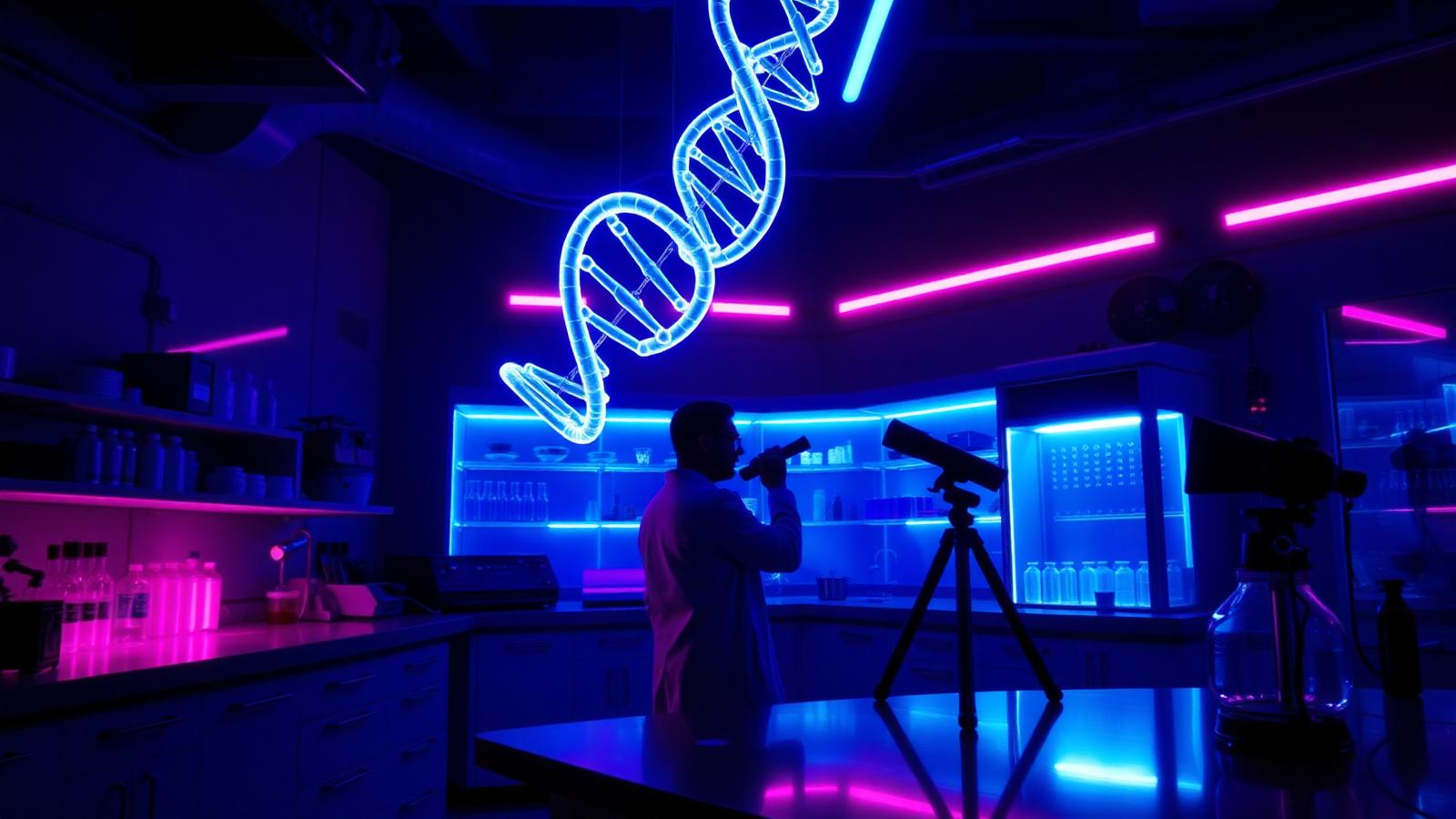
Futuristic laboratory glowing at night with a neon DNA helix and a scientist studying a telescope
Unit 10 · Future Frontiers

10A. Science fact, science fiction

B2 · 60–75 min · Apex English
Unit 10 · Quote
"Any sufficiently advanced technology is indistinguishable from magic."
Arthur C. Clarke
Lesson goals

By the end you will…

  • Use quantifiers ALL, EVERY, EACH, BOTH, EITHER, NEITHER, NONE, NO, MOST with correct verb agreement.
  • Distinguish ALL / EVERY / EACH and BOTH / EITHER / NEITHER in real contexts.
  • Use vocabulary of science & discovery: research, experiment, discover / discovery / discoverer, invent / invention / inventor, cure, breakthrough, launch, prove.
  • Predict stress shifts inside a word family (PHOtograph → phoTOgrapher → photoGRAphic).
  • Talk about which sci-fi predictions actually came true — and which never will.
1. Warm-up

Warm-up · science fact or science fiction?

5 min

Read each 'future prediction' below. In pairs, decide: is it FACT (it exists now), FICTION (still imaginary), or SOON (within 10 years)?

  1. #1A pill that lets you learn a language in a week.
  2. #2A robot surgeon that operates with better accuracy than any human.
  3. #3A tourist trip around the Moon that ordinary people can book online.
  4. #4A weather forecast that is 99% accurate seven days ahead.
  5. #5A cure for every type of cancer.
  6. #6A translator earpiece that lets two strangers talk in different languages in real time.

💬 Listen to your partners — how many of them said 'ALL of these will happen' vs 'NONE of these will happen'? Those are today's quantifiers.

2. Lead-in

Lead-in: match the invention to the year

6 min

In pairs, match each real scientific breakthrough on the LEFT to the year on the RIGHT. Be brave — guess before you check.

🧪 Breakthrough
  • A. The first successful heart transplant
  • B. The launch of the James Webb Space Telescope
  • C. The first mRNA vaccine approved for humans
  • D. The first photograph of a black hole
  • E. The publication of the human genome
  • F. The first crewed landing on the Moon
📅 Year
  • 1 · 1969
  • 2 · 1967
  • 3 · 2003
  • 4 · 2019
  • 5 · 2020
  • 6 · 2021
✅ Show suggested answers
  • A → 2 · 1967 (Christiaan Barnard, South Africa)
  • B → 6 · 2021 (Christmas Day launch)
  • C → 5 · 2020 (COVID-19 vaccines)
  • D → 4 · 2019 (Event Horizon Telescope)
  • E → 3 · 2003 (Human Genome Project completed)
  • F → 1 · 1969 (Apollo 11)

💬 Twist question: which of these breakthroughs did NONE of us predict correctly? Which did ALL of us know?

A humanoid robot and a scientist collaborating in a futuristic lab
3. Reading

Reading: 'five predictions that came true — and five that didn't'

10 min

In 1968, the writer Arthur C. Clarke described a small handheld device that would let people read newspapers from anywhere in the world, receive messages instantly, and watch moving pictures on a bright screen. He called it a 'newspad'. He was, of course, describing the smartphone — thirty years before anyone actually built one. Most of Clarke's other predictions came true too: satellite communications, the personal computer, video calls. He got the timing almost right.

Not every science-fiction prediction has aged so well. Both writers and scientists in the 1960s promised us flying cars by the year 2000, colonies on Mars by 2010, and a cure for every disease by 2020. None of those has happened. All of them are still 'coming soon'. Meanwhile, nobody in 1968 predicted that the biggest technological change of the 21st century would be a piece of glass in your pocket that shows you videos of strangers dancing.

The pattern is clear. Predictions about MACHINES tend to be too optimistic: we thought we would have robot butlers and personal jetpacks by now. Predictions about SOFTWARE and INFORMATION tend to be too PESSIMISTIC: none of the great writers of the 1960s imagined a single company knowing what four billion people had for breakfast. Every generation of scientists gets some of it right, some of it wrong — and almost none of it in the order they expected.

What no science-fiction writer of the 20th century really predicted was the speed of biological discovery. In just three years — 2020 to 2023 — the world designed, tested, produced and delivered several new vaccines to billions of people, decoded the structure of nearly every human protein with AI, and began human trials of gene-editing cures for sickle cell and blindness. Every one of these was, until very recently, pure science fiction.

Comprehension

  1. What was Arthur C. Clarke's 'newspad'?

  2. According to the text, predictions about MACHINES have been…

  3. What TYPE of prediction has been TOO pessimistic?

  4. How does the text describe the pace of biological science 2020–2023?

  5. Which sentence best summarises the text?

Science vocabulary in context

Match each word from the text with its closest meaning.

  • prediction
  • breakthrough
  • trial
  • decode
  • gene-editing
  • colony
4. Vocabulary

Vocabulary: science, discovery & invention

12 min

Science vocabulary lives in FAMILIES — one root produces a verb, a noun (thing), a noun (person) and an adjective. Learn them together and you'll double your fluency this lesson.

Word families — the four columns

discover · discovery · discoverer · discovered
verb / noun (thing) / noun (person) / adjective
invent · invention · inventor · inventive
verb / noun / person / adjective (creative)
research · research · researcher · well-researched
verb & noun same form / person / adjective
explore · exploration · explorer · exploratory
verb / noun / person / adjective
analyse · analysis · analyst · analytical
verb / noun / person / adjective
prove · proof · — · proven
verb / noun / — / adjective

Science verbs — what scientists DO

carry out research / an experiment
collocation: NOT 'do a research'
test a hypothesis
an idea that hasn't been proved yet
publish (a paper / findings)
put results in a journal
launch (a mission / a satellite)
send into space
develop (a vaccine / a cure)
create over time through research
fund / finance
pay for the research

Big science nouns

breakthrough
a major sudden step forward
cure
a medicine that ends a disease
vaccine
prevents you catching a disease
hypothesis / theory / law
increasing levels of proof
peer review
other scientists check the work
clinical trial
test of a new treatment on people

Adjectives to describe research

groundbreaking
changing the whole field
controversial
people strongly disagree about it
cutting-edge / state-of-the-art
the newest and most advanced
peer-reviewed
checked by other scientists
inconclusive
the results didn't prove anything clearly
reproducible
other scientists can get the same result

Practice

Complete each sentence with ONE word from the box (correct form). One word per gap.

Word bank — drag or tap, then tap a gap
  1. The team spent ten years to  drop  a vaccine for the virus.
  2. Marie Curie was the first person to win two Nobel Prizes for her  drop  into radioactivity.
  3. The James Webb Space Telescope was  drop  on Christmas Day, 2021.
  4. This paper hasn't been  drop  yet — three other labs still need to check it.
  5. Alexander Fleming's  drop  of penicillin in 1928 changed medicine forever.
  6. The results of the first  drop  were disappointing, but the second one worked.
  7. AI is now used to  drop  millions of images faster than any human could.
  8. For decades, scientists tried to  drop  that the theory was correct.
5. Grammar focus

Grammar: quantifiers — all, every, each, both, either, neither, none

15 min

1. ALL — 'the total group' (plural verb)

ALL is followed by a plural or uncountable noun, and takes a PLURAL verb. • All experiments FAIL sometimes. • All (of) the results ARE in. • All (of) the information IS on the website. (uncountable → singular verb)

2. EVERY / EACH — 'every one, one by one' (singular verb)

EVERY and EACH are followed by a SINGULAR noun and a SINGULAR verb. • Every prediction WAS wrong. (NOT 'were wrong') • Each scientist HAS a different theory. • Difference: EVERY = 'all of them, thought of as a group'; EACH = 'one by one, individually'. • EVERY needs 3+ items; EACH can be 2+.

3. BOTH — 'the two of them' (plural)

BOTH is used for TWO things and takes a PLURAL verb. • Both theories ARE interesting. • Both (of) the astronauts SURVIVED. Position with the verb 'be': the noun/pronoun goes first: 'The results are both surprising.' / 'They are both scientists.'

4. EITHER / NEITHER — 'one of two' / 'not one of two' (singular)

EITHER = 'one or the other of two' (singular verb). NEITHER = 'not one and not the other of two' (formally singular). • Either theory IS possible. • Neither experiment WAS successful. ⚠ In spoken English, 'neither of us HAVE been' is very common — but in writing, use IS/HAS.

5. NONE / NO — 'zero' (singular OR plural)

NO + noun = 'not any' (usually singular verb with singular noun, plural with plural noun). NONE (OF) + plural noun = plural OR singular verb (both accepted; plural is more natural in speech). • No student HAS finished. / No students HAVE finished. • None of the experiments HAVE worked. / None of the experiments HAS worked. ✗ 'I don't have no time.' (double negative) → ✓ 'I have NO time / I don't have ANY time.'

6. MOST — 'the majority' (plural / uncountable)

MOST + plural / uncountable noun. • Most scientists AGREE with the theory. • Most (of the) research SUPPORTS the idea. ⚠ 'Most of the' (with THE) points to a specific group; 'Most' alone is general.

Exercise A — pick the correct quantifier

Choose ALL, EVERY, EACH, BOTH, EITHER, NEITHER, NONE or NO.

  1. ___ scientist in the lab has their own project.
  2. ___ of the two theories has been proved yet.
  3. There are two candidates and I like ___ of them.
  4. ___ the results were ready by Friday.
  5. ___ of the ten experiments has produced clear evidence.
  6. There's ___ time to run another trial before the deadline.
  7. The two labs are working together and ___ have published papers.
  8. ___ prediction Clarke made about screens turned out to be correct.

Exercise B — spot & fix the mistake

Each sentence has ONE mistake. Rewrite it correctly.

  1. Every scientists in the room agreed.
  2. All the information are online.
  3. Neither of the two theories are correct.
  4. I don't have no funding for this project.
  5. Both of experiments failed.
  6. Most of scientists agree on climate change.
  7. None of the results was a surprise.
  8. Each of the astronauts have their own capsule.

Exercise C — rewrite with a quantifier

Rewrite each sentence using the quantifier in brackets.

  1. Not one of the ten predictions was right. (NONE)
  2. The two astronauts came back safely. (BOTH)
  3. There isn't a single result yet. (NO)
  4. 100% of the students passed. (ALL)
  5. Considered one by one, the labs are different. (EACH)
  6. The majority of the research supports the theory. (MOST)

Exercise D — a science-news gap-fill

Complete the text with ONE word from the box (each used once).

everyallbotheachneithernonenomosteitherany

In 2023, a small British startup and a much larger American lab announced, on almost the same day, that they had made progress on a room-temperature superconductor. (1) ___ teams claimed a breakthrough; (2) ___ of them had, so far, been able to reproduce the result. Independent scientists tried to repeat the experiment in fourteen laboratories around the world. (3) ___ single one succeeded.

That, however, isn't the end of the story. (4) ___ scientist working in condensed-matter physics agrees: a real superconductor at room temperature would change (5) ___ major industry on Earth — from energy to transport to medicine. So (6) ___ month, at least one new paper appears on the topic, and (7) ___ of the recent ones are more careful than the previous wave. There is still (8) ___ proof, but there is (9) ___ ongoing hope and serious money. As (10) ___ of the researchers told the BBC last week: 'One of these attempts, sooner or later, is going to work.'

6. Pronunciation

Pronunciation: stress in word families

8 min

Inside a word family, the stress usually MOVES when you add certain suffixes. Predict the shift and you'll sound like a real B2 speaker of scientific English.

  • Nouns ending in -TION / -SION / -ITY: stress on the syllable BEFORE the suffix. dis-CO-ver → dis-CO-ver-Y → dis-cov-er-ER — but pre-DICT → pre-DIC-tion; pos-SI-ble → pos-si-BI-li-ty.
  • Adjectives ending in -IC / -ICAL / -IOUS: stress on the syllable BEFORE the suffix. PHO-to-graph → pho-to-GRA-phic; SCI-ence → sci-en-TI-fic.
  • Verbs ending in -ISE / -IZE: stress DOESN'T move. MO-dern → MO-der-nise; UR-ban → UR-ban-ise.
  • Adjectives ending in -ABLE / -FUL / -LESS: stress DOESN'T move. AF-ford → af-FOR-dable (careful — 'afford' is already stressed on 2!); PRE-dict → pre-DIC-table.
  • The stress rule you'll actually use most: '-ION and -ITY pull the stress ONE syllable back.'

Listen and repeat (stress shift within a word family)

Say each set aloud. Feel the stress JUMP when a suffix is added. Two clearly different voices in the audio.

🎧 Stress-shift drill inside word families (two clearly different voices) — audio coming soon (transcript below)
  • SCI-ence → sci-en-TI-fic → SCI-en-tist
  • PHO-to-graph → pho-to-GRA-phic → pho-TO-gra-pher
  • dis-CO-ver → dis-CO-very → dis-CO-verer
  • pre-DICT → pre-DIC-tion → pre-DIC-table
  • AN-a-lyse → a-NA-ly-sis → a-na-LY-ti-cal → AN-a-lyst
  • TE-chno-lo-gy → tech-no-LO-gi-cal → tech-NO-lo-gist
  • COM-mu-ni-cate → com-mu-ni-CA-tion → com-MU-ni-ca-tive
  • e-CO-no-my → e-co-NO-mic → e-co-NO-mi-cal → e-CO-no-mist

Practice — say the sentence aloud

Read each sentence aloud. Mark where the stress falls in the CAPITALISED word.

  1. The scienTIfic method is not perfect, but it's the best we have.
  2. Her DIScovery of a new exoplanet made every front page.
  3. The techNOlogist gave a talk on the futUre of clean energy.
  4. The COMmunicative AI robot answered every question politely.
  5. The ecoNOmic impact of the vaccine was enormous.
  6. The photoGRAphic evidence proved the theory beyond doubt.
7. Listening

Listening: 'the podcast — one prediction that came true, one that didn't'

12 min

Two guests on a science podcast — Dr Ana Ribeiro, a British astrophysicist, and Marcus Chen, a Californian science-fiction novelist — debate one prediction that came true and one that didn't. Two clearly different voices, no name-introductions in the audio.

🎧 Dr Ana Ribeiro (astrophysicist) & Marcus Chen (novelist) — two clearly different voices — audio coming soon (transcript below)

Before you listen

  • Predict: which single prediction do you think the SCIENTIST will say came true?
  • Predict: which prediction do you think the NOVELIST will say still hasn't come true?
Show transcript

Speaker A:OK — let's start with the fun question. One prediction from twentieth-century science fiction that really came true. Ana, you first.

Speaker B:Easy. The smartphone. Arthur C. Clarke, 1968, described a small handheld device with a bright screen — you could read newspapers on it from anywhere, receive messages instantly, watch moving pictures. He was off by about thirty years, but essentially every detail was correct.

Speaker A:Every detail?

Speaker B:Every important one. Portability, brightness, instant news, video. All of it. What he couldn't predict was that most of us would use it to send each other pictures of our lunch.

Speaker A:Fair. My turn — one prediction that didn't come true, and probably never will. Flying cars.

Speaker B:Oh, the flying car — every sci-fi film since 1962 has promised us the flying car.

Speaker A:Every single one. And none of them will ever fly, honestly, as everyday transport. The physics is against them. A small flying vehicle uses roughly twenty times more energy per kilometre per passenger than a road car. Neither the batteries nor the fuel exists to make it work at scale.

Speaker B:That is a very sad sentence for anyone who grew up reading Isaac Asimov.

Speaker A:It is. But — and this is the good news — both of us have been surprised in the other direction too. Neither of us predicted, ten years ago, that we would have gene-editing cures for sickle cell disease and inherited blindness in actual patients by 2024.

Speaker B:Nor that an AI system would write and code as well as most professionals. All the writers I know are quietly panicking.

Speaker A:That's the pattern. Every generation of sci-fi writers overestimates the hardware — the jetpacks, the humanoid robots, the flying cars — and underestimates the software. Nobody in 1968 predicted the search engine. Nobody predicted the social network. Nobody predicted the AI that writes essays.

Speaker B:Confession time — I wrote a novel in 2005 where every home has a personal humanoid robot doing the dishes by 2020. None of that has happened. Not one of the robots we promised is actually useful. I regret every page of that book.

Speaker A:Don't regret it. That's what sci-fi is FOR — to be gloriously, expensively wrong, so that reality can surprise us in a completely different direction.

Speaker B:So — final question. Where's the NEXT big surprise coming from? Space? AI?

Speaker A:Biology. Every serious scientist I know says the same. Not from space, not from robotics — from biology. Both of us should be paying attention.

Speaker B:Agreed. Biology it is. Thanks, Ana. That's our episode.

First listen — gist

  1. What is the topic of the podcast episode?
  2. Which prediction does the SCIENTIST celebrate as 'really having come true'?
  3. Which prediction does the NOVELIST complain about?

Second listen — detail

  1. According to the scientist, how far off was Clarke about the smartphone?
  2. Why does the novelist say flying cars will 'probably never' be everyday transport?
  3. What TWO recent predictions have both guests been surprised by?
  4. What does the scientist say science-fiction writers usually GET WRONG?
  5. What ONE prediction does the novelist say she now regrets writing?
  6. How do they end the episode?
🎧 Authentic Listening · real voices

What science-fiction got right (and wrong) — a Science Report

Source: Original Apex English script · inspired by the VOA Learning English format · Apex English original script — recording in production. Explore real VOA reports on this topic via the source link.

B1+ → B2≈ 2:30 (script)

A short report in the VOA Learning English style: which 20th-century sci-fi predictions actually came true. The audio recording is on its way — for now, read the script and answer the questions.

🎧 Audio in production. For now, read the full script below and answer the gist / detail questions — then compare with a partner. The recording will appear here as soon as it's ready.

1. Listen for gist

  • In ONE sentence, what is the main idea of the report?
  • Which single 20th-century prediction is celebrated as 'essentially correct'?
  • Where does Dr Iyer expect the fastest breakthroughs in the next 20 years?

2. Listen for detail

  1. In what year did Clarke describe his handheld device?
  2. How far off was he about the smartphone?
  3. Name TWO 1960s predictions that have NOT come true.
  4. Where does Dr Iyer work?
  5. According to the report, what type of prediction is usually too PESSIMISTIC?

3. Glossary

prediction
a statement about what will happen in the future
breakthrough
a major, sudden step forward
handheld
small enough to hold in one hand
colony
a permanent settlement in a new place
gene editing
changing the DNA of a living organism
📄 Full script

From VOA Learning English, this is the Science and Technology report.

Sixty years ago, science-fiction writers made bold predictions about the year 2020. Some of them were extraordinarily accurate. Others were extraordinarily wrong. And the pattern tells us something important about how the future arrives.

In 1968, the British writer Arthur C. Clarke described a handheld screen that could show newspapers, films and video calls from anywhere in the world. He was, essentially, describing the smartphone — thirty years before it existed. Every important detail was correct.

But not every prediction has aged well. Both writers and scientists in the 1960s promised us flying cars by the year 2000, permanent colonies on Mars by 2010, and a cure for every disease by 2020. None of those has happened. All of them are still 'coming soon'.

Doctor Priya Iyer, who studies the history of science at Cambridge, says there is a pattern. Predictions about MACHINES tend to be too optimistic — we thought we would have robot butlers and personal jetpacks by now. Predictions about SOFTWARE tend to be too pessimistic. Almost no one in 1968 predicted the search engine, or a website that would know what four billion people had for breakfast.

The real surprise of the last few years, Doctor Iyer says, has been BIOLOGY. Every serious scientist she speaks to agrees: the fastest breakthroughs of the next twenty years will not come from space or from robots, but from gene editing, vaccines and clean protein — and most of them will surprise even the researchers who make them.

That's the Science and Technology report. I'm Anna Matteo.

4. Discuss in pairs

  • Which prediction from a book or film do YOU still think will come true?
  • Which prediction do you think will NEVER come true, and why?
  • In your country, which technology of the last 10 years surprised most people?
8. Speaking

Speaking: 'the 2050 prediction game'

10 min

In pairs, make FIVE predictions for the world in 2050. You MUST use: (a) THREE quantifiers (all / every / most / none / both / neither), (b) TWO science-family words (discovery / researcher / technological…), (c) ONE 'still' or 'no longer' to show change over time.

Step 1
Health
'By 2050, most cancers will be…', 'All new medicines will…'
Step 2
Space
'Every year, we will…', 'Neither Mars nor the Moon will still be…'
Step 3
AI
'No student will still write essays by hand because…'
Step 4
Climate
'Most cities will have…', 'Both energy and transport will…'
Step 5
Daily life
'None of us will still use…', 'Every home will have…'
👀 Show model pitch

By 2050, most of the common cancers will have a cure. Every child will be vaccinated against malaria at birth. Both electric and hydrogen cars will be normal, and none of us will still use petrol on a daily basis. Every big city will have a low-emission zone, and neither London nor São Paulo will still allow diesel in the centre. No student will hand-write an essay any more — every one of them will co-write with an AI, and that will be completely normal. And, honestly, one groundbreaking discovery none of us can yet predict will change everything.

🏆 Extra ⭐ if you sneak in a word family (discover / discovery / discoverer) AND 'neither X nor Y' in the same prediction.

9. Writing

Writing mini-task — 'a prediction for 2050' (120–150 words)

5 min (or homework)

Write a short prediction essay: (1) one paragraph on what WILL happen by 2050, (2) one paragraph on what will NOT have happened. Use at least THREE quantifiers, TWO word-family items and ONE 'either / neither' structure.

The James Webb Space Telescope in deep space with a swirling nebula behind it
10. Wrap-up

Wrap-up · three finish-the-sentence prompts

3 min

Pick ONE and finish it out loud. Class votes on the boldest prediction.

Row 1 · Prompt 1 — the confident prediction
By 2050, every… because…
Row 2 · Prompt 2 — the safe bet
None of us will still… by 2035, and that's because…
Row 3 · Prompt 3 — the wild card
One discovery neither science nor fiction has predicted yet is…
🎮 Games arena

Play to remember

🃏 Quantifiers & science word-family flashcards

1 / 20

Click to reveal the meaning

🧬 Match: quantifier / word ↔ rule (60s)

60s0/8

Tap a word on the left, then its meaning on the right. Beat the clock!

Challenge

End-of-lesson quiz · Science fact, science fiction

15 questions · 70% to pass · instant feedback after you submit.

  1. Q1.___ scientist in the lab has their own specialism.

  2. Q2.___ of the two theories has been proved.

  3. Q3.All the information ___ online.

  4. Q4.The two labs are working together and ___ have published papers.

  5. Q5.___ of the ten trials has produced clear evidence.

  6. Q6.There's ___ time to run another experiment.

  7. Q7.Most scientists ___ on climate change.

  8. Q8.The noun formed from 'discover' meaning 'the person' is…

  9. Q9.Where does the stress fall in 'scientific'?

  10. Q10.Where does the stress fall in 'photographer'?

  11. Q11.Which sentence is CORRECT?

  12. Q12.Which sentence is CORRECT?

  13. Q13.The verb 'launch' most often collocates with…

  14. Q14.A 'peer-reviewed' paper is one that…

  15. Q15.Which word is a SYNONYM of 'breakthrough'?

0/15 answered

📚 Homework

Practise at home

Open the Workbook for extra exercises with answer keys — quantifiers, science word-families, and stress in word families.