
In 1999, at the Champions League final in Barcelona, Manchester United were 1–0 down to Bayern Munich as the match entered injury time. Almost nobody in the stadium believed United could still win. And yet, in the space of two minutes, two substitutes — Teddy Sheringham and Ole Gunnar Solskjær — both scored, and United lifted the trophy. Their manager, Sir Alex Ferguson, said afterwards that Bayern had 'defended too deep' and should have killed the game off in normal time. The German commentator, on live television, kept repeating that it 'can't have happened' — even as it was happening.
Unit 7 · Workbook
7A. Game on — Workbook
Extra practice for home study · with answer keys
How to use this workbook
- Try each exercise on paper first — don't peek!
- Tap Show answer on a single item, or use the big button above to reveal everything.
- Re-do anything you got wrong the next day.
1. Vocabulary — sports & competition
Choose the word or phrase that fits best.
The underdogs pulled off an incredible ___ to win 3–2.
The ___ awarded a penalty after checking VAR.
She's been the ___ champion for three years running.
The captain got ___ off in the first half for a bad tackle.
It ended 1–1 — a fair ___ for both sides.
You don't 'win somebody' in English — you ___ them.
Important notes
Ask the teacher: Write down anything you want to remember from this section. Your notes are saved automatically.
Auto-saving
2. Vocabulary — officiating gap-fill
Complete each sentence with ONE word or phrase from the box (correct form).
Word bank — drag or tap, then tap a gap
- The referee drop a penalty after the handball.
- Our team hasn't drop a single goal in five matches.
- The goal was drop for offside after a video review.
- He got a drop for arguing with the fourth official.
- She was drop in the sixtieth minute — the team had to play with ten.
- It was still 0–0 after ninety minutes, so we went to drop .
Important notes
Ask the teacher: Write down anything you want to remember from this section. Your notes are saved automatically.
Auto-saving
2b. Vocabulary — discursive writing
Write 120–180 words: 'Is the win at all costs mentality in modern sports damaging to the spirit of fair play? Discuss the role of officiating and competition.'
Check your writing
- Use target lexis from the sports and officiating sections
- Use varied C1-level grammar (e.g. mixed conditionals or inversion)
- Ensure logical cohesion and smooth transitions
- Maintain a formal or semi-formal academic register
Important notes
Ask the teacher: Write down anything you want to remember from this section. Your notes are saved automatically.
Auto-saving
3. Grammar — past modals for deduction
Choose the correct past modal.
She's celebrating with a medal. She ___.
The stadium is empty. The game ___ yet.
He's limping badly. He ___ himself in training.
The gates are locked. The match ___ hours ago.
The ref waved play on — he ___ the elbow.
Nobody's talking. They ___ the final.
There's no way. He's the world number one — he ___ that badly.
She was ten metres clear at the last check-point. She ___ the race.
Important notes
Ask the teacher: Write down anything you want to remember from this section. Your notes are saved automatically.
Auto-saving
4. Grammar — should have / shouldn't have
Rewrite each situation as a criticism or regret using SHOULD HAVE or SHOULDN'T HAVE.
We didn't train hard enough. (regret)
The coach substituted the top scorer too early. (criticism)
I ate a huge meal before the race. (regret)
The defender wasn't marking his player at the corner.
You told the ref he was blind. That was a bad idea.
We didn't book the tickets in advance and they sold out.
Important notes
Ask the teacher: Write down anything you want to remember from this section. Your notes are saved automatically.
Auto-saving
5. Grammar — would rather
Rewrite each sentence using WOULD RATHER (with same or different subject).
I prefer to watch football at home.
I'd prefer it if you didn't shout at the TV.
She prefers to sleep than to train tonight.
I'd prefer it if we talked about something else.
He'd prefer not to go to the pub after the match.
I'd prefer it if the ref used VAR for every penalty.
Important notes
Ask the teacher: Write down anything you want to remember from this section. Your notes are saved automatically.
Auto-saving
6. Grammar — spot & fix the mistake
Each sentence has ONE mistake. Rewrite it correctly.
He must had trained really hard.
I should of gone to the game.
They can't lost — I just saw them celebrating.
I'd rather to stay home tonight.
I'd rather you don't mention that match.
She might have to twist her ankle in the warm-up.
Important notes
Ask the teacher: Write down anything you want to remember from this section. Your notes are saved automatically.
Auto-saving
7. Reading — true / false / not given
Read the short text and mark each statement T, F or NG.
- United were losing 1–0 going into injury time.T / F / NG
- United won because of two goals by the same player.T / F / NG
- Sir Alex Ferguson said Bayern should have attacked more in normal time.T / F / NG
- The German commentator used 'can't have happened' during the match.T / F / NG
- The two scoring substitutes were both English.T / F / NG
- The match was played in Barcelona.T / F / NG
Important notes
Ask the teacher: Write down anything you want to remember from this section. Your notes are saved automatically.
Auto-saving
8. Writing — guided task
Write 80–100 words about a real (or imagined) match you'll never forget. Use at least 2 past modals (must/should/can't have) and 1 WOULD RATHER.
Check your writing
- 80–100 words
- 2+ past modals (must/should/can't have)
- 1+ WOULD RATHER structure
- At least 2 sports vocab words
Important notes
Ask the teacher: Write down anything you want to remember from this section. Your notes are saved automatically.
Auto-saving
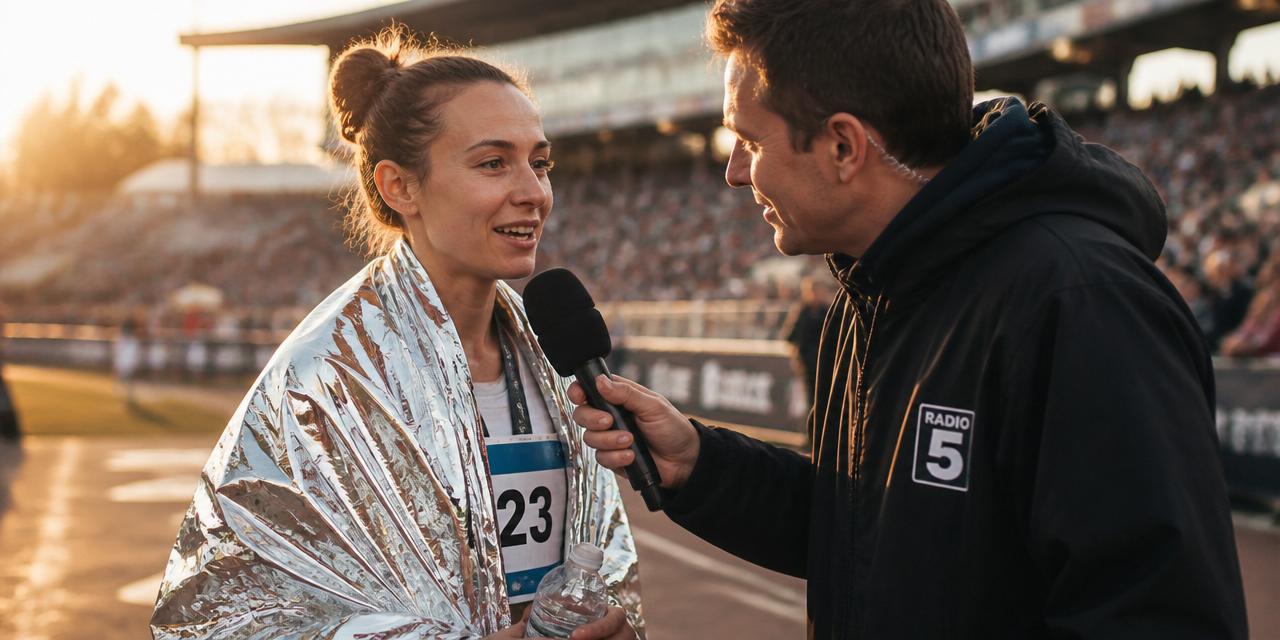
9. Listening — post-marathon interview
Listen to the interview (interviewer + athlete — clearly different voices). Answer the questions. Play twice if you need.
🎧 Post-marathon interview · ≈ 1:30
📄 Show transcript
A: Chloe, congratulations! You just won the London Marathon. How does Chloe feel after winning?
B: Oh, thank you so much! Honestly, it hasn't sunk in yet — I still can't believe I've won.
A: Incredible. We saw you were quite far back for a long time. At the 20 km mark, what position were you in?
B: I was tenth. I knew I had a lot of work to do.
A: You certainly did. Your coach was beaming. What did her coach say she must have run the last 10 km at?
B: He said I must have run it at a personal-best pace. He couldn't believe the acceleration.
A: And the defending champion dropped out unexpectedly. Why does she think the defending champion dropped out?
B: I think she must have been carrying an injury she didn't tell anyone about. It's the only explanation really.
A: Some commentators suggested you should have gone for it sooner. What do some commentators think she should have done?
B: They thought I should have attacked earlier in the race.
A: And what is her honest reaction to that criticism?
B: My honest reaction? I'd rather trust my own strategy — attacking at 15 km could have made me 'blow up'. I stuck to my plan.
A: A very successful plan, it turns out! One final question: What does she want to do this week?
B: Sleep rather than train, definitely! I'm absolutely exhausted.
- How does Chloe feel after winning?
- At the 20 km mark, what position was she in?
- What did her coach say she must have run the last 10 km at?
- Why does she think the defending champion dropped out?
- What do some commentators think she should have done?
- What is her honest reaction to that criticism?
- What does she want to do this week?
Important notes
Ask the teacher: Write down anything you want to remember from this section. Your notes are saved automatically.
Auto-saving
10. Dictation — key sentences
Listen again and complete each line with the missing words.
🎧 Marathon interview — key sentences
📄 Show transcript
A: Chloe, congratulations! You just won the London Marathon. How does Chloe feel after winning?
B: Oh, thank you so much! Honestly, it hasn't sunk in yet — I still can't believe I've won.
A: Incredible. We saw you were quite far back for a long time. At the 20 km mark, what position were you in?
B: I was tenth. I knew I had a lot of work to do.
A: You certainly did. Your coach was beaming. What did her coach say she must have run the last 10 km at?
B: He said I must have run it at a personal-best pace. He couldn't believe the acceleration.
A: And the defending champion dropped out unexpectedly. Why does she think the defending champion dropped out?
B: I think she must have been carrying an injury she didn't tell anyone about. It's the only explanation really.
A: Some commentators suggested you should have gone for it sooner. What do some commentators think she should have done?
B: They thought I should have attacked earlier in the race.
A: And what is her honest reaction to that criticism?
B: My honest reaction? I'd rather trust my own strategy — attacking at 15 km could have made me 'blow up'. I stuck to my plan.
A: A very successful plan, it turns out! One final question: What does she want to do this week?
B: Sleep rather than train, definitely! I'm absolutely exhausted.
- I still believe I've .
- My coach said I have run the last ten kilometres at a pace.
- She have been carrying an she didn't tell anyone about.
- Some commentators said I have earlier.
- I'd trust my own .
- I'd rather than train right now.
Important notes
Ask the teacher: Write down anything you want to remember from this section. Your notes are saved automatically.
Auto-saving
11. 🔥 Challenge — sentence transformation
Rewrite the second sentence using 2–5 words including the KEYWORD.
1. I'm sure he trained very hard. → He ___ very hard. (KEYWORD: MUST)
2. It's impossible she saw the foul. → She ___ the foul. (KEYWORD: CAN'T)
3. My advice is not to shout at the ref. Too late. → You ___ at the ref. (KEYWORD: SHOULDN'T)
4. I prefer to watch it at home. → I ___ it at home. (KEYWORD: RATHER)
5. Please don't talk about that match. → I ___ about that match. (KEYWORD: RATHER)
6. Perhaps she injured her ankle in the warm-up. → She ___ her ankle in the warm-up. (KEYWORD: MIGHT)
Important notes
Ask the teacher: Write down anything you want to remember from this section. Your notes are saved automatically.
Auto-saving
12. 🔥 Challenge — the weak 'have' quiz
Which spoken version is CORRECT natural English?
'He must have known'
'She should have called'
'They can't have finished'
'You could have won'
Which written form is CORRECT?
Which written form is CORRECT?
Important notes
Ask the teacher: Write down anything you want to remember from this section. Your notes are saved automatically.
Auto-saving
13. 🔥 Challenge — odd one out
Three items share a category. Pick the ODD ONE OUT.
1. Officiating vocabulary:
2. Ways to lose badly / one-sidedly:
3. Certainty about the past:
4. WOULD RATHER + bare infinitive (same subject):
Important notes
Ask the teacher: Write down anything you want to remember from this section. Your notes are saved automatically.
Auto-saving
14. 🔥 Challenge — extended writing
Write a 130–160 word 'match report or opinion piece' about a real or imagined game/race. Use AT LEAST 3 past modals (must / can't / should have) and 2 WOULD RATHER structures. Use at least 4 sports vocab words.
Check your writing
- 130–160 words
- 3+ past modals (must / can't / should have)
- 2+ WOULD RATHER structures
- 4+ sports vocab words from section 4
Important notes
Ask the teacher: Write down anything you want to remember from this section. Your notes are saved automatically.
Auto-saving
15. Self-check
Tick what you can now do confidently.
- I use MUST HAVE / CAN'T HAVE / MIGHT HAVE + past participle to speculate about the past.
- I use SHOULD HAVE / SHOULDN'T HAVE + past participle to express regret or criticism.
- I use WOULD RATHER + bare infinitive for same-subject preferences.
- I use WOULD RATHER + subject + past simple for different-subject preferences.
- I know that 'should of' is WRONG — the correct form is 'should HAVE'.
- I pronounce 'must have / should have / could have' with the weak /əv/.
- I can describe sports, competition and officiating with B2 vocabulary.
Important notes
Ask the teacher: Write down anything you want to remember from this section. Your notes are saved automatically.
Auto-saving