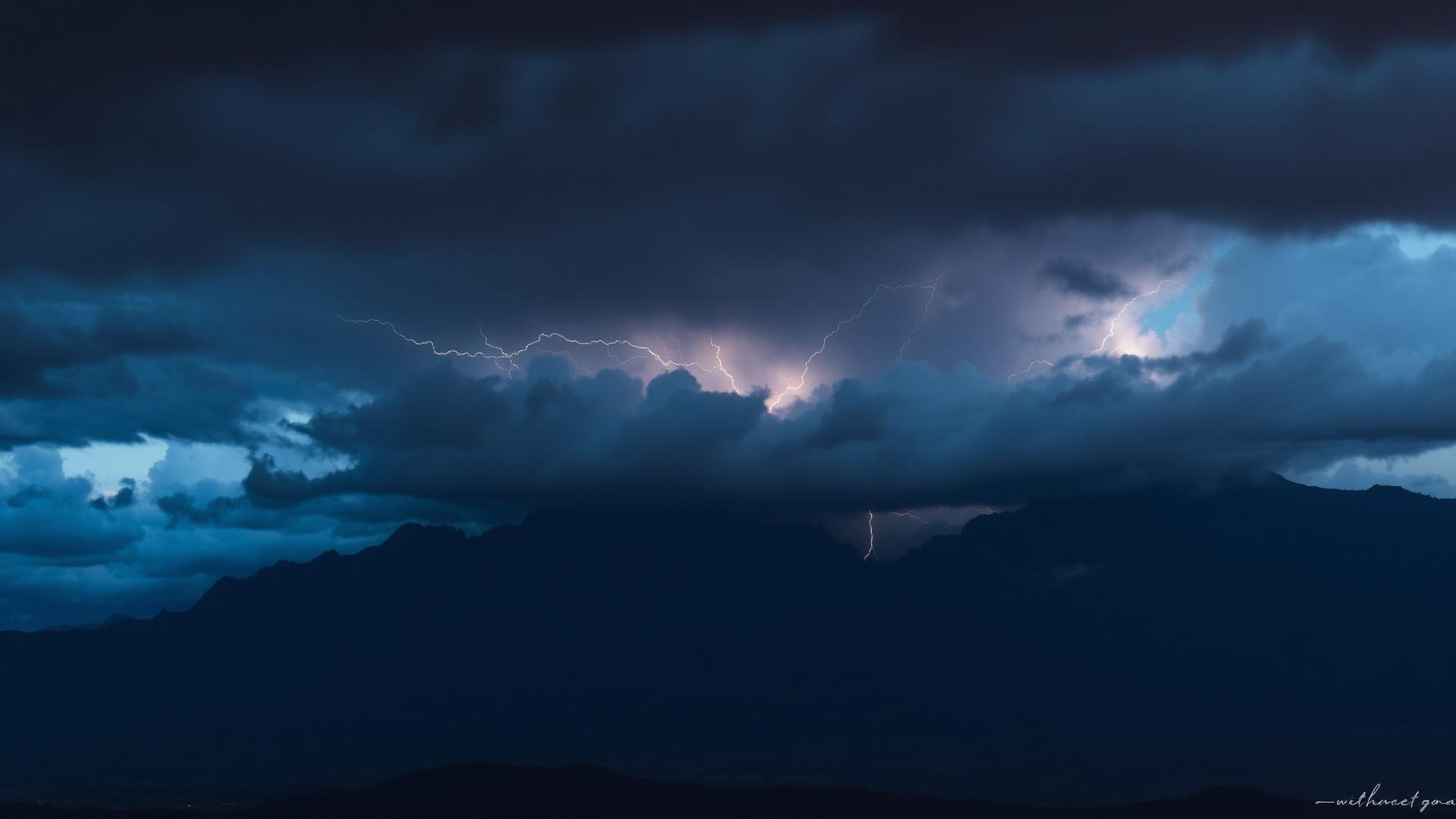
Dramatic storm clouds and lightning over a mountain ridge at dusk.
Unit 4 · Wild Planet

4A. Forces of nature

B2 · 60–75 min · Apex English

Unit 4 · Quote
"Nature always wears the colours of the spirit."
Ralph Waldo Emerson
Lesson goals

By the end you will…

  • Use the future perfect (will have done) to talk about actions finished before a point in the future.
  • Use the future continuous (will be doing) to talk about actions in progress at a point in the future.
  • Describe extreme weather and environmental change with accurate B2 vocabulary.
  • Distinguish and produce the key English vowel sounds /iː/, /ɪ/, /æ/, /ʌ/, /ɜː/, /ɔː/, /uː/.
1. Warm-up

Warm-up · the storm-o-meter

5 min

Look at the weather scale below. On a scale of 1 (a light breeze) to 10 (full-on hurricane), how would you rate the weather you REMEMBER most vividly? Share the story with a partner in 60 seconds.

👈 Light breeze— — —Full hurricane 👉
  1. #1I've been caught in a thunderstorm with absolutely no shelter.
  2. #2I've genuinely seen snow for the first time as an adult.
  3. #3I've experienced a heatwave so bad I couldn't sleep for a week.
  4. #4I've been on a plane during severe turbulence.
  5. #5I've felt a real earthquake — or something that shook the building.
  6. #6I've swum in the sea during a proper storm.

💬 Notice: 'I've been…', 'I've seen…', 'I've felt…'. Later today, we'll shift into the FUTURE: 'By 2050, I will have seen…' and 'This time next year, I'll be living somewhere with better weather.'

2. Lead-in

Lead-in: predict the planet

8 min

Below are six predictions about our planet in the next 30 years. In pairs, decide: LIKELY, POSSIBLE, or NEVER. Justify each answer. You have three minutes.

🔮 The predictions
  • 1. By 2050, most cars on the road will be electric.
  • 2. By 2050, humans will have colonised the Moon.
  • 3. By 2040, half the world's coral reefs will have disappeared.
  • 4. In ten years, we'll be flying in fully autonomous planes.
  • 5. By 2035, we'll have banned single-use plastic worldwide.
  • 6. In twenty years, people in Northern Europe will be growing oranges in their gardens.
🔎 Discussion hints
  • Which trend is already happening?
  • Which prediction is technology-driven, and which is climate-driven?
  • Which country would you bet on to make it real first?
  • Which prediction would you MOST like to be wrong about?
✅ Show suggested answers
  • 1. LIKELY — EV sales have overtaken petrol in several markets already.
  • 2. NEVER (in that time frame) — a small research base, maybe; a colony, no.
  • 3. LIKELY — the IPCC estimates 70–90% loss with 1.5 °C of warming.
  • 4. POSSIBLE — cargo yes, passenger flights probably not by 2036.
  • 5. POSSIBLE — treaties are moving, but enforcement is slow.
  • 6. LIKELY in a warmer climate — southern England is already growing wine.

💬 Look at the grammar you just used: 'will HAVE disappeared', 'will BE flying', 'will HAVE banned'. Two different futures, two different meanings — that's today's focus.

Storm waves crashing on cliffs
3. Reading

Reading: the century of extremes

10 min

Meteorologists have started calling the 21st century 'the century of extremes'. In just the last decade, we have watched wildfires devour whole Californian towns, floods swallow entire neighbourhoods of Pakistan, and heatwaves shatter records from Sicily to Siberia. And, if the models are right, we are only at the beginning.

According to the World Meteorological Organization, by 2050 more than three billion people will be living in areas that experience extreme heat for at least one month a year. In cities like Cairo, Delhi and Phoenix, summer nights will rarely drop below 30 °C. Farmers who grew wheat for generations will be growing sorghum or nothing at all.

The oceans, too, are changing. In some parts of the Pacific, sea surface temperatures will have risen by more than 2 °C by the middle of the century. Half of the world's coral reefs, scientists warn, will have bleached beyond recovery. Storms will be forming further from the equator, and hurricane season will be starting weeks earlier than it does today.

It is not all bad news. Reforestation projects in Ethiopia, Rwanda and Costa Rica have already planted billions of trees. By the end of this decade, the European Union will have installed enough offshore wind capacity to power thirty million homes. Cities from Copenhagen to Curitiba are proving that a modern life can be low-carbon.

What no expert doubts is this: the world that our children will be living in will look, sound and feel quite different from ours. The question is not whether nature will change us — it is whether we, in time, will have changed the way we treat it.

Comprehension

  1. What does the phrase 'the century of extremes' refer to?

  2. By 2050, more than three billion people will…

  3. What will happen to hurricane season, according to the text?

  4. Which of these is presented as GOOD news?

  5. The writer's final message is that…

Weather & environment vocabulary in context

Find these words in the text and match them to the closest meaning.

  • wildfire
  • flood
  • heatwave
  • reef
  • bleach (a reef)
  • offshore wind
4. Vocabulary

Vocabulary: the environment & extreme weather

10 min

At B2, we upgrade from 'It's rainy' to specific, precise weather and environment words — the kind you meet on the news, in documentaries, and in real conversations about the planet.

Extreme weather (nouns)

a heatwave
long period of very hot weather
a drought
long period of no rain, so no water
a flood
when land is covered by water
a blizzard
a heavy snowstorm with strong wind
a hurricane / typhoon
a very strong tropical storm
a wildfire
a fast, uncontrolled fire in nature

Weather adjectives

humid
the air feels wet and heavy
boiling / freezing
extreme hot / extreme cold (informal)
mild
not hot, not cold — pleasant
chilly
a little too cold, but not freezing
overcast
grey, completely covered with cloud
scorching
extremely hot, burning

Environment (nouns & verbs)

climate change
long-term shift in weather patterns
global warming
rising average world temperature
emissions
gases released into the air (esp. CO₂)
renewable energy
energy from wind, sun, water, etc.
to pollute
to make air / water / land dirty
to preserve
to keep something safe from harm

Verbs of nature's power

to devour
to eat / destroy quickly and completely
to swallow
to cover completely (water swallows land)
to shatter (a record)
to break by a huge amount
to erupt
(volcano) to explode; to burst out
to strike
(lightning, disaster) to hit suddenly
to melt
to turn from solid to liquid (ice → water)

Practice

Complete each sentence with ONE word or phrase from above (correct form). More than one answer may be possible.

Word bank — drag or tap, then tap a gap
  1. Farmers in Spain lost half their harvest because of a two-year  drop  .
  2. Solar and wind are the fastest-growing forms of  drop   drop  .
  3. The Arctic sea ice is  drop  faster than scientists predicted.
  4. A  drop  shut down the airport for four days last January.
  5. It's  drop  outside — I need a jumper.
  6. Cars in the city centre  drop  the air more than factories now.
  7. The 2023 summer  drop  shattered records across southern Europe.
  8. The wildfire  drop  20,000 hectares of forest in three days.
5. Grammar focus

Grammar focus: future perfect & future continuous

15 min

1. Future continuous — will be + -ing

For an action IN PROGRESS at a point in the future. • This time tomorrow, I'll be flying to Iceland. • At 8 p.m. on Sunday, they'll be watching the storm on the news. Also for planned / expected future events (softer than 'will'): • I'll be seeing Ana next week anyway — I'll ask her.

2. Future perfect — will have + past participle

For an action FINISHED before a point in the future. • By 2050, half the reefs will have disappeared. • By the time you arrive, I'll have finished packing. Often with 'by + time', 'by the time…', 'in X years'.

3. The two contrasted

At 10 p.m. tonight, I'll be studying. (in progress at 10 p.m.) By 10 p.m. tonight, I'll have studied for four hours. (finished before 10 p.m.) At lunchtime, they'll be building the roof. (in progress) By lunchtime, they'll have built the roof. (already done)

4. Negatives & questions

Continuous: I won't be working on Saturday. / Will you be using the car? Perfect: They won't have arrived by 6. / Will she have finished by then?

5. Common time signals

Future continuous: this time tomorrow / next week, at 3 o'clock, all day, this evening. Future perfect: by 2030, by the time…, in ten years' time, before you know it.

6. Neither for immediate plans

Don't use them for things happening RIGHT NOW or for arrangements today. ✗ 'I'll have called her in a minute.' → ✓ 'I'll call her in a minute.' ✗ 'I'll be seeing you in five minutes.' → ✓ 'I'll see you in five minutes.'

Exercise A — future continuous or future perfect?

Complete each sentence with the verb in CAPITALS in the future continuous OR future perfect.

  1. This time tomorrow, we ___ (fly) over the Atlantic.
  2. By 2030, scientists ___ (map) the entire ocean floor.
  3. Don't call at 8 — I ___ (watch) the football.
  4. By the time you finish reading this, another hectare of forest ___ (burn).
  5. At midnight, most of the city ___ (sleep) through the storm.
  6. In ten years, we ___ (install) solar panels on half of Europe's roofs.

Exercise B — put the sentence in order

Put the words in the correct order.

  1. have / by 2040 / risen / sea levels / will
  2. will / this time next week / lying / I / on a beach / be
  3. the roof / by lunchtime / built / they / have / will
  4. will / all afternoon / be / it / snowing
  5. have / before you know it / it / stopped / raining / will

Exercise C — spot & fix the mistake

Each sentence has ONE mistake. Rewrite it correctly.

  1. By 2050 the ice caps will melting completely.
  2. This time tomorrow I will have swimming in the sea.
  3. By the time she arrives, we finished dinner.
  4. At 9 tonight I will been studying.
  5. By 2030 they will build the new dam.
  6. I'll have seeing you tomorrow morning.

Exercise D — gap-fill weather forecast (2050 edition)

Read the future weather bulletin and put ONE verb from the box in each gap — future perfect OR future continuous.

will be shiningwill have doubledwill be rainingwill have disappearedwill be blowingwill have risenwill be flowingwill have floodedwill be arrivingwill have reachedwill be sitting

Good morning, and welcome to the 2050 weather bulletin. As you drink your coffee, the sun (1) ___ over central Europe, but by lunchtime storm Elena (2) ___ from the Atlantic coast.

By this afternoon, sea levels along the Dutch coast (3) ___ by another eight centimetres compared to yesterday, and by tomorrow they (4) ___ several low-lying farms in Zeeland. Emergency water (5) ___ through the new drainage tunnels all night.

Further south, temperatures in Andalusia (6) ___ 46 °C by 3 p.m., and by the end of the week the summer heatwave record (7) ___ compared to 2049. A strong dry wind (8) ___ from the Sahara all weekend.

In Arctic news, sadly, most of this year's summer sea ice (9) ___ by September. Meanwhile, viewers in northern England: at bedtime, you (10) ___ heavily, so keep the umbrella by the door. And at midnight, half of you (11) ___ under an extra blanket. Stay safe out there.

6. Pronunciation

Pronunciation: the key English vowel sounds

8 min

English vowels are famously slippery — six written vowels stand for around twenty sounds. Master a small set well and your accent instantly becomes clearer.

  • /iː/ vs /ɪ/ — long tense 'ee' vs short lax 'i'. sheep / ship, heat / hit, leave / live.
  • /æ/ vs /ʌ/ — front open 'a' vs central open 'uh'. cat / cut, ran / run, hat / hut.
  • /ɜː/ — long central 'er' with rounded lips, no /r/ sound in British English. bird, work, learn, heard.
  • /ɔː/ vs /ɒ/ — long rounded 'aw' vs short 'o'. caught / cot, port / pot, storm / stop.
  • /uː/ vs /ʊ/ — long tense 'oo' vs short lax 'u'. pool / pull, fool / full, Luke / look.
  • In connected speech, unstressed vowels usually reduce to /ə/ (schwa): 'the' /ðə/, 'a' /ə/, 'to' /tə/, 'from' /frəm/.

Listen and repeat (vowel minimal-pair drill)

Say each pair twice: exaggerate the difference the first time, then say them at natural speed.

  • /iː/ vs /ɪ/ — sheep / ship · heat / hit · leave / live · beach / bitch (careful!)
  • /æ/ vs /ʌ/ — cat / cut · ran / run · hat / hut · lack / luck
  • /ɜː/ — bird · work · learn · heard · third · turn
  • /ɔː/ vs /ɒ/ — caught / cot · port / pot · storm / stop · saw / sock
  • /uː/ vs /ʊ/ — pool / pull · fool / full · Luke / look · food / foot
  • Schwa (/ə/) — a report of a storm from the coast → /ə rɪˈpɔːt əv ə stɔːm frəm ðə kəʊst/

Practice — nature sentences

Read each sentence aloud with a partner, paying attention to the vowel sound in CAPITALS.

  1. The sh/iː/p and the sh/ɪ/p both crossed the sea safely.
  2. The h/eː/twave in Athens sh/ʌ/ttered the record.
  3. The b/ɜː/d f/ɜː/st learned to fly on the third of March.
  4. The st/ɔː/m walked slowly across the c/ɒ/ast.
  5. The p/uː/l was f/ʊ/ll of leaves after the storm.
  6. In a m/ɔː/ment, the sky t/ɜː/ned from blue to gr/eː/.
7. Listening

Listening: the storm chasers

12 min

Two friends, Priya (a science journalist) and Marco (a very anxious traveller), are looking at the weather forecast the night before a hiking trip to the mountains.

🎧 Priya & Marco — the storm chasers

Before you listen

  • Have you ever cancelled a trip because of the weather? What happened?
  • Predict: does Marco go on the trip or not? Why do you think so?
Show transcript

Priya:Alright, so, the forecast: Saturday's a mess. A cold front will be arriving from the west around 2 p.m., and the storm will be blowing through the valley for about six hours.

Marco:Six hours? On the ridge? With no shelter? Priya, absolutely not.

Priya:Nobody is hiking in a storm. Sunday, though — look. By 8 a.m. the sky will have cleared, and by lunchtime it'll be boiling.

Marco:Boiling in the mountains? In April?

Priya:Twenty-three degrees, easily. So the plan is: we start at first light on Sunday, we hike up while it's still chilly, and by ten we'll be standing at the summit.

Marco:And by the time we come down, everyone else will just be leaving the car park.

Priya:Exactly. But listen — proper waterproof jacket. No plastic ponchos. If we're wrong about the timing, we don't want to be freezing three hours from the car.

Marco:Fine. And at ten on the summit, we take a photo, we send it to Ana, and we tell her that while she's still asleep, we've already conquered the mountain.

Priya:Now you're talking. By the end of Sunday, we'll have walked twenty-two kilometres, we'll have eaten our body weight in chocolate, and we'll be sleeping like babies.

Marco:…and by Monday, my legs will have completely given up on me.

First listen — gist

  1. What is the weather forecast for the weekend?
  2. What is Marco most worried about?
  3. What do they decide in the end?

Second listen — detail

  1. What time will the storm be arriving on Saturday?
  2. How long will the storm be blowing through the valley?
  3. By what time on Sunday will the sky have cleared?
  4. What piece of gear does Priya insist on packing?
  5. What weather word does Marco use for the sky in the second half of the dialogue?
  6. What do they agree to do at the summit at 10 a.m. Sunday?
🎧 Authentic Listening · real voices

2023: the hottest year on record

Source: VOA Learning English — Environment Report (adapted, 2024) · Adapted from VOA Learning English (public domain)

B1–B2 · slowed news English≈ 3:00

A VOA-style environment report on the hottest year ever recorded and what it means for the future. Listen first without the transcript.

Tip: listen ONCE for gist (general meaning), then again with the transcript hidden for detail. Open the transcript only for a third listen.

1. Listen for gist

  • What was special about 2023, according to the report?
  • What two things worked TOGETHER to make it so hot?
  • Is there any good news in the report?

2. Listen for detail

  1. Which agency released the report?
  2. Who is Samantha Burgess?
  3. Which month was the hottest ever recorded?
  4. What happened in Canada that summer?
  5. How did scientists describe September's temperatures?
  6. What does Burgess say about the 1.5 °C limit?
  7. What historic first happened in the EU in 2023?

3. Glossary

pre-industrial
before the industrial revolution (roughly before 1850)
fossil fuels
coal, oil and gas — energy from ancient carbon
El Niño
a natural warming of the Pacific that raises global temperatures
off the chart
so extreme it goes beyond the normal scale
renewables
energy from wind, sun, water — sources that don't run out
fraction (of a degree)
a small part — even 0.1 °C matters
📄 Show full transcript

Welcome to the VOA Learning English Environment Report. I'm Faith Pirlo.

The year 2023 was the hottest year ever recorded on planet Earth. That is according to a report from the European climate service Copernicus. Scientists say average global temperatures for the year were nearly 1.5 °C above pre-industrial levels — the target level that world leaders agreed, in Paris in 2015, they would try never to cross.

Samantha Burgess is the deputy director of the Copernicus Climate Change Service. She said the extreme temperatures were made worse by two things happening at the same time: the continued burning of fossil fuels, and a natural weather pattern called El Niño.

The report describes a year of striking extremes. In July, average global temperatures reached the hottest ever recorded for that month. Wildfires devoured huge areas of forest in Canada. In August, sea surface temperatures broke records around the world. And in September, temperatures were so unusually high that scientists described them simply as 'off the chart'.

Burgess said the world will probably cross the 1.5 degree line at some point in the next few years. But that, she said, does not mean it is too late to act. Every fraction of a degree matters.

In another piece of good news, 2023 was also the year in which renewable energy — mainly solar and wind — produced more of the world's electricity than at any point in history. In the European Union, wind farms alone produced more electricity than natural gas for the first time.

Experts say the message is simple: the climate is changing faster than expected, but the tools to slow it down are already in our hands. Whether we will use them, quickly enough, is the question that will define the 21st century.

4. Discuss in pairs

  • By 2050, do you think YOUR country will have kept its climate promises? Why / why not?
  • Which change would be easiest for you to make personally: less flying, less meat, or less driving?
  • The report ends with 'a question that will define the 21st century'. In one sentence, how would YOU answer that question?
8. Speaking

Speaking: your life in 2050

10 min

You have ONE minute to describe your OWN life in the year 2050. In your talk, you MUST use at least: (a) TWO future continuous sentences ('I'll be living…'), (b) TWO future perfect sentences ('I will have…'), (c) ONE piece of environment vocabulary ('renewable energy', 'heatwave'…), (d) ONE weather adjective. Judge listens and gives ⭐ for each one used naturally.

Step 1
Where you'll be living
City, country, climate — use future continuous.
Step 2
What you'll be doing daily
Job, hobby, routine — future continuous.
Step 3
What you'll have achieved
Career, family, travel — future perfect.
Step 4
How the planet will have changed
Environment vocabulary + future perfect.
Step 5
Your biggest hope
One optimistic prediction.
👀 Show model pitch

In 2050, I'll be living in a small wooden house just outside Lisbon, near the coast. It'll be scorching by then — summers of forty degrees will be totally normal. Every morning I'll be walking my dog along the beach before work. By then, I will have written three novels, I will have travelled to Antarctica, and my daughter will have finished university. Portugal will have installed solar panels on almost every roof, and, honestly, I think we will have finally stopped burning coal. My biggest hope? That my grandchildren will be swimming in a cleaner sea than the one I grew up with.

🏆 Extra ⭐ if you use 'by the time…' naturally: 'By the time I'm sixty, I will have…'

9. Writing

Writing mini-task — 'a letter to my future self' (100–120 words)

5 min (or homework)

Write a short letter to yourself, to be opened in 2050. You MUST use: (a) at least 3 future perfect sentences, (b) 2 future continuous sentences, (c) 2 words of environment / weather vocabulary. Underline every grammar target you use.

Reforestation valley at dawn
10. Wrap-up

Wrap-up · the prediction ladder

3 min

Climb the ladder: each row is one confident prediction about the world. Share yours with a partner and vote on which is the most likely.

Row 1 · 1 prediction — by next year
Something small and personal (future perfect).
Row 2 · 2 predictions — by 2035
One about YOU, one about your city.
Row 3 · 3 predictions — by 2050
About the planet — climate, cities, food (mix future perfect + future continuous).
🎮 Games arena

Play to remember

Two quick games. Earn up to ⭐⭐⭐ stars on each.

🃏 Weather & environment flashcards

1 / 16

Click to reveal the meaning

⚡ Weather–meaning match (60s)

60s0/8

Tap a word on the left, then its meaning on the right. Beat the clock!

Challenge

End-of-lesson quiz · Forces of nature

12 questions · 70% to pass · instant feedback after you submit.

  1. Q1.Choose the MOST natural sentence.

  2. Q2.Which sentence uses the FUTURE CONTINUOUS correctly?

  3. Q3.Complete: "By the time you get here, I ___ dinner."

  4. Q4.Which sentence has a MISTAKE?

  5. Q5.Which is a synonym for 'a long period of unusually hot weather'?

  6. Q6.Complete: "Solar and wind are the fastest-growing forms of ___ ."

  7. Q7.Which pair of words has the SAME vowel sound?

  8. Q8.Which sentence uses 'BY' + future perfect correctly?

  9. Q9.Choose the CLOSEST meaning of TO SHATTER (a record).

  10. Q10.Complete: "Don't call at 8 — I ___ the football."

  11. Q11.Which word means 'to make air, water or land dirty'?

  12. Q12.Listening recall — when will Priya and Marco actually do the hike?

0/12 answered

📚 Homework

Practise at home

Open the Workbook for extra exercises with answer keys — vocabulary, grammar, reading, dictation and vowel-sound challenges.