
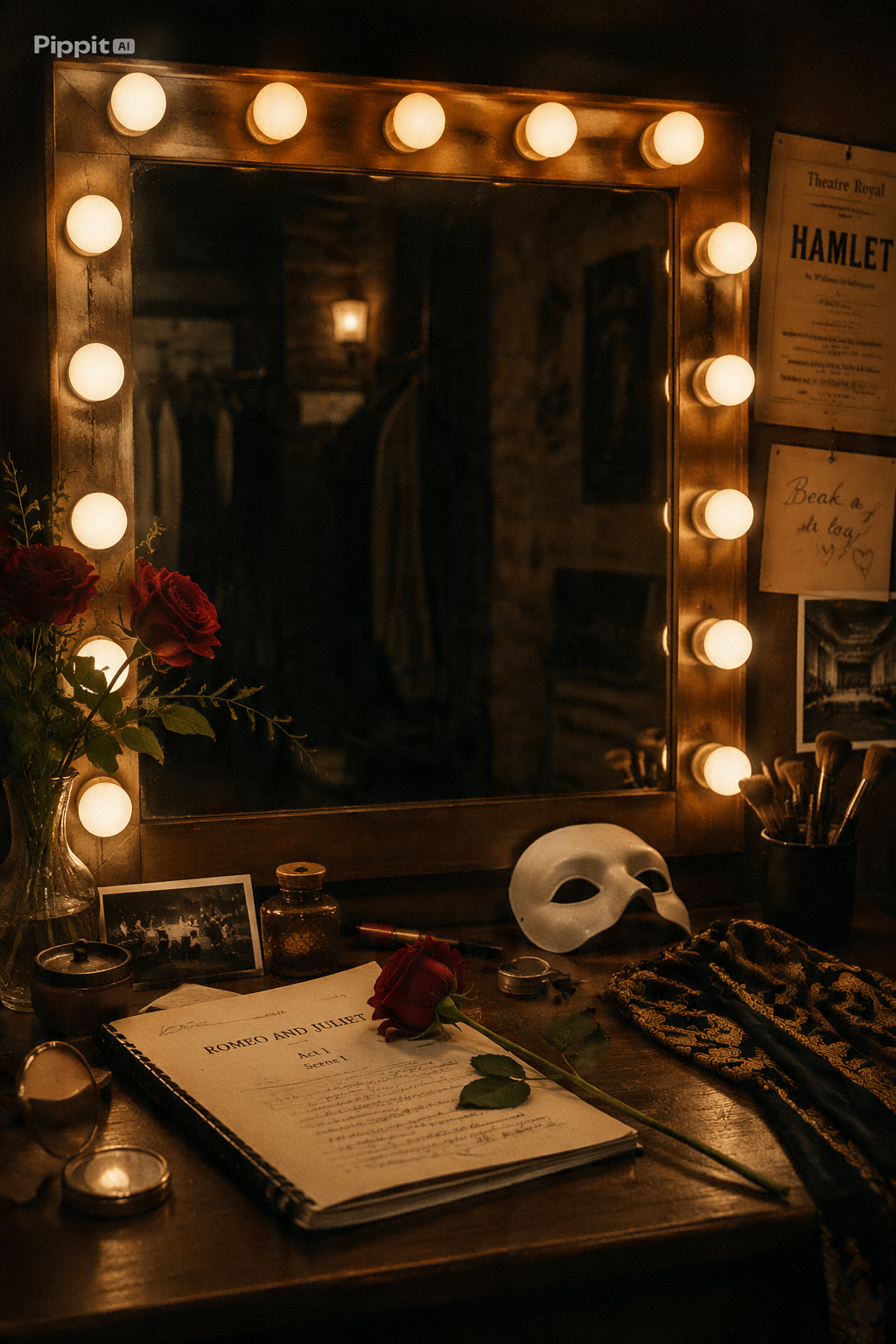
In the famous 1988 revival of 'The Phantom of the Opera' on Broadway, a large chandelier is designed to fall from the ceiling towards the audience. On the opening night, a small mechanical fault meant the chandelier stopped halfway. The lead actor, without breaking character, simply looked up, sighed, shrugged his shoulders, and delivered his next line early. The audience, sensing something was wrong but not quite understanding what, applauded anyway. Backstage, twelve technicians were running in complete silence, trying to fix the mechanism. The chandelier finished its fall — three minutes late — during a musical number that was originally supposed to be a quiet duet. The next morning, the review in The New York Times called the moment 'the best piece of improvisation on Broadway in a decade'.
7B. The show must go on — Workbook
Extra practice for home study · with answer keys
How to use this workbook
- Try each exercise on paper first — don't peek!
- Tap Show answer on a single item, or use the big button above to reveal everything.
- Re-do anything you got wrong the next day.
1. Vocabulary — body & movement
Choose the word that fits best.
She didn't answer — she just ___ her shoulders and walked off.
Please ___ — the actors are about to start.
The audience ___ when the acrobat missed the bar.
He kept ___ at the ceiling all through the interview — he was clearly bored.
The old man ___ on his walking stick and made his way down the aisle.
The lead dancer ___ down beside the pianist to whisper instructions.
Ask the teacher: Write down anything you want to remember from this section. Your notes are saved automatically.
2. Vocabulary — backstage gap-fill
Complete each sentence with ONE word or phrase from the box (correct form).
- During drop , twenty crew members move in perfect silence.
- The stage manager waited in drop , waiting for the perfect moment.
- He almost forgot to bring drop — the small silver key that unlocks the plot.
- The huge castle wall is one of the heaviest drop in the show.
- The lead actor missed her drop and stared into space for two full seconds.
- The magic happens on stage; the mistakes happen drop .
Ask the teacher: Write down anything you want to remember from this section. Your notes are saved automatically.
2b. Vocabulary — discursive writing
Write 120–180 words: 'The magic of theatre depends on the seamless coordination between what happens on stage and backstage. Discuss the physical and technical demands of a live performance.'
Check your writing
- Use target lexis from the body movement and backstage sections
- Use varied C1-level grammar (e.g. inversion or cleft sentences)
- Ensure logical cohesion and smooth transitions
- Maintain a formal or semi-formal academic register
Ask the teacher: Write down anything you want to remember from this section. Your notes are saved automatically.
3. Grammar — verbs of the senses (+ adjective / like / as if)
Choose the correct form.
You look ___.
It sounds ___ a great idea.
He looks ___ he's about to cry.
This costume feels ___ silk, but it's polyester.
The dressing room smells ___ vanilla — is someone burning a candle?
The old actor's voice sounds ___ tonight — hoarse and quiet.
It smells ___ old wood and hairspray back here.
You look ___ you've seen a ghost.
Ask the teacher: Write down anything you want to remember from this section. Your notes are saved automatically.
4. Grammar — see / look at / watch and hear / listen to
Choose the more natural verb.
'Every Saturday, we ___ the football together.'
'Look! Can you ___ that plane?'
'___ this new song — I love it!'
'I ___ a strange noise coming from the wings.'
'Please ___ your lines one more time before the show.'
'I ___ that new play at the National last week.'
Ask the teacher: Write down anything you want to remember from this section. Your notes are saved automatically.
5. Grammar — rewrite with SENSE verbs
Rewrite each sentence using a verb of the senses (look / sound / feel / taste / smell).
I think you're tired.
This soup has too much salt in it.
I have the impression that he's about to faint.
I think that idea is a good one.
The material is like real silk.
The room has a very stuffy atmosphere tonight.
Ask the teacher: Write down anything you want to remember from this section. Your notes are saved automatically.
6. Grammar — spot & fix the mistake
Each sentence has ONE mistake. Rewrite it correctly.
You look happily today.
It sounds a great idea.
He looks he is angry.
I was seeing the match on TV yesterday.
Listen this song, please.
The costume feels as silk.
Ask the teacher: Write down anything you want to remember from this section. Your notes are saved automatically.
7. Reading — true / false / not given
Read the short text and mark each statement T, F or NG.
- The chandelier is supposed to fall towards the audience.T / F / NG
- The lead actor stopped the show when the fault happened.T / F / NG
- The audience realised exactly what had gone wrong.T / F / NG
- Twelve technicians ran to fix the chandelier backstage.T / F / NG
- The chandelier eventually fell during a solo song.T / F / NG
- The New York Times review was written by a former actor.T / F / NG
Ask the teacher: Write down anything you want to remember from this section. Your notes are saved automatically.
8. Writing — guided task
Write 80–100 words describing a place you know well using the five senses. Use at least 4 SENSE verbs (look / sound / feel / taste / smell) and 1× AS IF / LIKE + clause.
Check your writing
- 80–100 words
- 4+ SENSE verbs (look / sound / feel / taste / smell)
- 1+ AS IF / LIKE + clause
- At least 2 body/movement verbs
Ask the teacher: Write down anything you want to remember from this section. Your notes are saved automatically.
9. Listening — backstage interview
Listen to the interview (interviewer + performer — clearly different voices). Answer the questions. Play twice if you need.
📄 Show transcript
A: Welcome back to 'Behind the Curtain'. Today, we have the incredible Amara Jenkins with us after a truly captivating performance. Amara, thank you for joining us.
B: My pleasure. It was a challenging one tonight!
A: Speaking of which, Amara, we have to ask: What happened to Amara in Act Three? We heard some whispers backstage...
B: Oh, that! Yes. I nearly fainted — the stage lights felt twice as hot as usual and her heart was pounding. It was a bit touch-and-go there.
A: Wow! But from out front, frankly, no one noticed. How did the audience react?
B: They noticed nothing — from the seats she 'looked completely in control'. Which is what you hope for, right? Hide the panic!
A: Absolutely! And your scene partner, I assume they were aware? What did her scene partner do to check on her?
B: He was brilliant. Just glanced at her and mouthed 'are you okay?' between lines. A real pro.
A: It highlights just how much control you have to have. According to Amara, how much of a performance is choreographed?
B: Almost everything — where you stand, when you turn, where your eyes go. Every little detail is usually planned.
A: That's incredible. So, what are the ONLY things you can't (and shouldn't) fake on stage?
B: A real breath, a real tremble in the hand — the tiny real things. Those are the moments that truly connect.
A: That makes so much sense. Finally, Amara, you've done both film and theatre. Why does she prefer live theatre to film?
B: Live theatre feels alive — you hear the audience breathe, they smell the same dust in the lights. Film is beautiful but there's no danger. That unpredictability is what I love.
- What happened to Amara in Act Three?
- How did the audience react?
- What did her scene partner do to check on her?
- According to Amara, how much of a performance is choreographed?
- What are the ONLY things you can't (and shouldn't) fake on stage?
- Why does she prefer live theatre to film?
Ask the teacher: Write down anything you want to remember from this section. Your notes are saved automatically.
10. Dictation — key sentences
Listen again and complete each line with the missing words.
📄 Show transcript
A: Welcome back to 'Behind the Curtain'. Today, we have the incredible Amara Jenkins with us after a truly captivating performance. Amara, thank you for joining us.
B: My pleasure. It was a challenging one tonight!
A: Speaking of which, Amara, we have to ask: What happened to Amara in Act Three? We heard some whispers backstage...
B: Oh, that! Yes. I nearly fainted — the stage lights felt twice as hot as usual and her heart was pounding. It was a bit touch-and-go there.
A: Wow! But from out front, frankly, no one noticed. How did the audience react?
B: They noticed nothing — from the seats she 'looked completely in control'. Which is what you hope for, right? Hide the panic!
A: Absolutely! And your scene partner, I assume they were aware? What did her scene partner do to check on her?
B: He was brilliant. Just glanced at her and mouthed 'are you okay?' between lines. A real pro.
A: It highlights just how much control you have to have. According to Amara, how much of a performance is choreographed?
B: Almost everything — where you stand, when you turn, where your eyes go. Every little detail is usually planned.
A: That's incredible. So, what are the ONLY things you can't (and shouldn't) fake on stage?
B: A real breath, a real tremble in the hand — the tiny real things. Those are the moments that truly connect.
A: That makes so much sense. Finally, Amara, you've done both film and theatre. Why does she prefer live theatre to film?
B: Live theatre feels alive — you hear the audience breathe, they smell the same dust in the lights. Film is beautiful but there's no danger. That unpredictability is what I love.
- The stage lights twice as as usual.
- I could feel my pounding.
- I think I must have pale.
- My scene partner glanced at me and 'are you okay?'
- A real in the hand — those you can't fake.
- You hear the audience .
Ask the teacher: Write down anything you want to remember from this section. Your notes are saved automatically.
11. 🔥 Challenge — sentence transformation
Rewrite the second sentence using 2–5 words including the KEYWORD.
1. You seem tired. → You ___. (KEYWORD: LOOK)
2. He seems to be about to cry. → He ___ about to cry. (KEYWORD: AS IF)
3. This has the taste of coffee. → This ___ coffee. (KEYWORD: LIKE)
4. I watched the match on TV. → I ___ TV. (KEYWORD: WATCHED)
5. Pay attention to this song. → ___ this song. (KEYWORD: LISTEN)
6. That's a nice-sounding idea. → That ___ a nice idea. (KEYWORD: SOUNDS)
Ask the teacher: Write down anything you want to remember from this section. Your notes are saved automatically.
12. 🔥 Challenge — silent-letter quiz
Which LETTER is silent in each word?
'knight'
'wrestle'
'thumb'
'castle'
'sign'
'listen'
'honest'
'muscle'
Ask the teacher: Write down anything you want to remember from this section. Your notes are saved automatically.
13. 🔥 Challenge — odd one out
Three items share a category. Pick the ODD ONE OUT.
1. Body movements you make with your HEAD:
2. Voice / breath actions:
3. Words with a SILENT letter:
4. Verbs that need LIKE + noun after them:
Ask the teacher: Write down anything you want to remember from this section. Your notes are saved automatically.
14. 🔥 Challenge — extended writing
Write 130–160 words describing 'a moment I'll never forget from a live performance' (concert, play, sports event…). Use AT LEAST 4 SENSE verbs, 2 AS IF / LIKE + clause, 5 body/movement verbs, and 3 words with silent consonants.
Check your writing
- 130–160 words
- 4+ SENSE verbs (look / sound / feel / taste / smell)
- 2+ AS IF / LIKE + clause
- 5+ body/movement verbs
- 3+ silent-consonant words (whispered, knelt, thumb, sigh, castle, listened, wrong…)
Ask the teacher: Write down anything you want to remember from this section. Your notes are saved automatically.
15. Self-check
Tick what you can now do confidently.
- I use look / sound / feel / taste / smell + ADJECTIVE for a direct impression.
- I use SENSE + LIKE + noun to compare an impression to a thing or person.
- I use SENSE + AS IF / AS THOUGH + clause for a full comparison.
- I know when to use SEE, LOOK AT and WATCH (and HEAR vs LISTEN TO).
- I can describe body language and movement with at least 10 specific verbs.
- I do NOT pronounce the silent letters in knee, wrist, thumb, listen, sign, sigh.
- I can describe a place, a person or a scene using multiple senses in one paragraph.
Ask the teacher: Write down anything you want to remember from this section. Your notes are saved automatically.