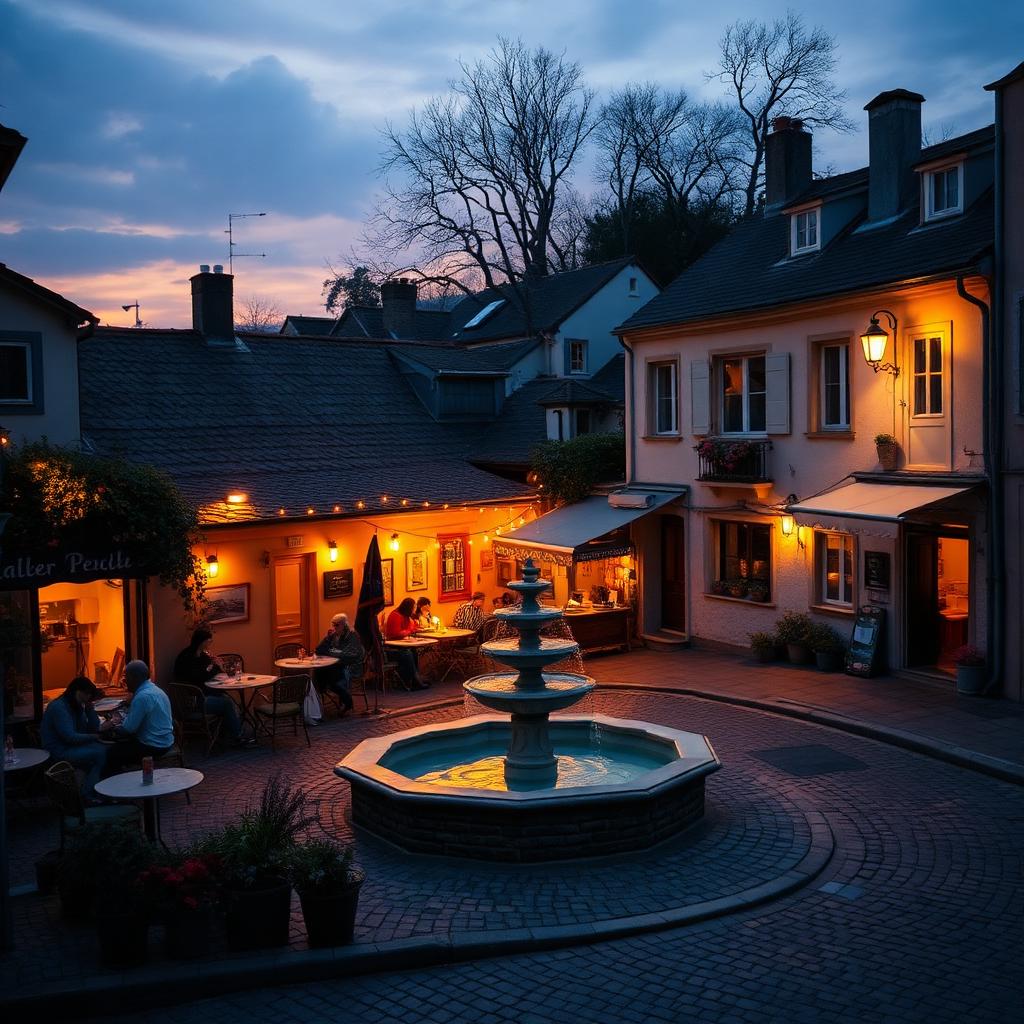
A warm hometown square at dusk with a fountain, café and string lights
🏡 Colloquial English 8&9 · Unit 9 extra

Talking about your hometown

B2 · 45–55 min · Apex English

Units 8 & 9 · Quote
"Home is not where you are born; home is where all your attempts to escape cease."— Naguib Mahfouz
Ask anyone about their hometown — they'll tell you who they are.
What is this?

Colloquial English — real, unscripted voices

Colloquial English takes a break from the textbook. Here, three people talk honestly about the town, village or city they call home — using the idioms, hesitations and warmth of real spoken English.

Three friends chatting on a bench in a small town square
1. Warm-up

Hometown bingo

5 min

Tick (✓) anything true for YOU. Then find a partner with the SAME tick and ask: "Tell me about it!"

2. Predict

What do you think you'll hear?

3 min

You'll hear three short interviews. Predict which words you'll probably hear — and which you won't.

miningvillagebakeryastronautreputationpenguincommunityportstarsskyscraper

(Spoiler: astronaut, penguin and skyscraper are NOT mentioned — everything else is.)

3. Listening — street interviews

Three people, three very different homes

15 min
🎧 🎙️ Interview: 'Tell me about your hometown.' — three clearly different voices — audio coming soon (transcript below)
Show transcript

Speaker 1 (A, English, mid-30s): Oh, I'm from a little place up in the north of England. Born and raised. It's an old mining town — nothing much to look at, honestly, and it's got a bit of a bad reputation. I left at twenty-two for London, thought I'd never come back. Ten years later, I moved back. London was killing me — the pace, the price, the fact that no one on my street even knew my name. Up here, everyone knows everyone. That's the best thing about it. It's also the worst thing about it. But honestly? It's a proper community. You cough on a Tuesday and someone brings you soup on the Wednesday. You don't get that in the city.

Speaker 2 (B, Portuguese, 60s): I live in a tiny village. Four hundred people. In the middle of nowhere, basically — an hour from the nearest supermarket. It's a sleepy little place. One café, one bakery, one bar, one very old church. But you can't beat it for stars at night. You really can't. And something interesting has happened: in the last five years, young families started moving in from Lisbon. Remote workers, mostly. The primary school reopened after being closed for ten years. That was extraordinary. I wouldn't change it for the world. It's not for everyone, of course. But it's mine.

Speaker 3 (C, Colombian, late 20s): I'm from a big port city in South America. Millions of people. Chaotic, loud, alive. And yes, it has a reputation — people who've never been assume it's dangerous everywhere, and it really isn't. That's the one thing I wish outsiders understood. It's not one city, it's forty neighbourhoods, and most of them are safe, funny, warm. The food is unbelievable. The music never stops. Strangers on the bus start conversations with you. If I ever left, that's what I'd miss the most — the way people are with each other. It's not for everyone. But for me, it's home.

A. Listen for gist

  1. In one line, describe each speaker's hometown.
  2. Which speaker LOVES their hometown but admits 'it's not for everyone'?
  3. Which speaker MOVED AWAY and then MOVED BACK?
  4. Which speaker's town has a BAD reputation that they think is unfair?
  5. What idea connects all three answers?

B. Listen for detail

  1. Speaker 1: WHY did they leave and WHY did they come back?
  2. Speaker 1: what's the best and worst thing about their hometown now?
  3. Speaker 2: how big is their village and what's it like?
  4. Speaker 2: what has changed in the village in the last few years?
  5. Speaker 3: what's the one thing they wish people understood about their city?
  6. Speaker 3: what would they miss if they left?
  7. Which speaker uses 'a proper community' and what do they mean?
  8. Which speaker ends with 'wouldn't change it for the world'?
4. Useful expressions

Hometown idioms you actually hear

8 min

Match each phrase to what it really means. Tap the answer to reveal.

  • born and raised (in)
  • a sleepy little place
  • in the middle of nowhere
  • put it on the map
  • the middle of the map
  • everyone knows everyone
  • it's not for everyone
  • you can't beat it (for X)
  • it's got a bad reputation, but…
  • up-and-coming
  • left for the big city
  • moved back after a few years
  • wouldn't change it for the world
  • a proper community
5. Pronunciation

Linking in fast, casual speech

6 min

In natural spoken English, words in a group often link into ONE sound: born‿and_raised sounds like /bɔːnən'reɪzd/. Listen for the link, imitate it. Don't say each word cleanly separated — nobody does.

🎧 Linking-in-fast-speech drill — say each pair with the link — audio coming soon (transcript below)
  • born and raised
    born‿and_raised
  • it's not for everyone
    it's not fer_everyone
  • you can't beat it
    you can't beat‿it
  • the middle of nowhere
    the middle‿o_nowhere
  • everyone knows everyone
    everyone knows‿everyone
  • I wouldn't change it for the world
    I wouldn't change‿it fer_the world
  • it's a proper community
    it's‿a proper_community
  • moved back after a few years
    moved_back‿after_a few years
🎧 Authentic Listening · real voices

The return-migration story — why people are moving back to small towns

Source: Original Apex English script · inspired by the VOA Learning English format · Apex English original script — recording in production. Explore real VOA reports on this topic via the source link.

B1+ → B2≈ 2:20 (script)

A short report in the VOA Learning English style: why so many people who left small towns are moving back — and what that's doing to their hometowns. Audio is on its way; for now, read the script and answer the questions.

🎧 Audio in production. For now, read the full script below and answer the gist / detail questions — then compare with a partner. The recording will appear here as soon as it's ready.

1. Listen for gist

  • In ONE sentence, what is the main finding of the report?
  • Which region is mentioned as a hotspot?
  • What are people mainly moving BACK for, according to Dr Ramos?

2. Listen for detail

  1. What has been the traditional story of small towns for decades?
  2. What has happened in some villages as a result of returners?
  3. Is the trend big, according to the OECD?
  4. What downsides does Dr Ramos warn about?
  5. How does Dr Ramos describe the return?

3. Glossary

return migration
people moving BACK to where they came from
priced out (of)
unable to afford to live somewhere
amenities
useful services — hospitals, schools, shops
born and raised
born there and grew up there
📄 Full script

From VOA Learning English, this is the Economics Report.

For decades, the story of small towns around the world has been the same. Young people leave for the big city, get an education, get a job, and never come back. The town gets older, the school closes, the bakery closes, the village slowly empties.

But now, in many countries, something new is happening. Remote workers, priced out of the biggest cities and tired of the pace, are moving back — sometimes to the exact village where they were born and raised.

Researchers at the OECD say the numbers are still small, but the trend is real. In Portugal, Spain, Italy and rural England, hundreds of villages have seen their populations rise for the first time in half a century. In some cases, primary schools that had been closed for ten years have reopened.

Doctor Elena Ramos, who studies rural economies, says the change is not only about money. People are coming back for a sense of community. They miss neighbours who know their name. They miss stars they can actually see at night. They miss the feeling of being from somewhere.

It's not for everyone, she warns. Remote villages still lack many amenities — from good hospitals to fast trains. But for those who choose it, the return, she says, is not a step backwards. It's the beginning of a new kind of hometown.

That's the Economics Report. I'm Anna Matteo.

4. Discuss in pairs

  • In your country, are people leaving small towns or moving back to them?
  • Would YOU move back to your hometown if you could work remotely? Why / why not?
  • What ONE amenity would a small village need to have before you'd consider moving there?
6. Role-play

'Tell me about your hometown'

10 min

In pairs. Student A is a curious traveller who has never been to Student B's hometown. Ask real questions; Student B answers using AT LEAST 4 idioms from Section 4.

Student A · the traveller
  • Where exactly is it?
  • How big is it? Sleepy or lively?
  • What's the best thing about growing up there?
  • What's the ONE thing outsiders always get wrong?
  • Would you ever leave? Would you move back?
Student B · the local
  • Use 'born and raised (in) …'
  • Use 'sleepy little place' OR 'in the middle of nowhere' OR 'up-and-coming'
  • Use 'it's got a bad reputation, but…' OR 'you can't beat it for…'
  • End with 'I wouldn't change it for the world' OR 'it's not for everyone, but…'
7. Writing mini-task

A 'hometown postcard' (80–100 words)

5 min

Write a short postcard-style paragraph introducing your hometown to a foreign friend. Use at least THREE idioms from Section 4 and TWO linking phrases from Section 5.

Challenge

End-of-lesson quiz · Talking about your hometown

10 questions · 70% to pass · instant feedback after you submit.

  1. Q1.'I was born and raised in Newcastle.' This means…

  2. Q2.'It's a sleepy little place — not much happens.' 'Sleepy' here means…

  3. Q3.'We're in the middle of nowhere.' This means the place is…

  4. Q4.'This café put our village on the map.' 'Put X on the map' means…

  5. Q5.'It's a small town — everyone knows everyone.' The speaker means…

  6. Q6.'It's got a bad reputation, but I love it.' 'Reputation' here means…

  7. Q7.'You can't beat it for stars at night.' This means…

  8. Q8.'I wouldn't change it for the world.' The speaker feels…

  9. Q9.'It's up-and-coming.' This describes a neighbourhood that is…

  10. Q10.Which sounds MOST natural when a friend asks about your hometown?

0/10 answered